
Germantown Previous Residents by Era
One Germantown address can have an ownership trail, an occupant trail, and a construction trail. The parcel and deed sources are best for recorded transfers. Directories and released census schedules add household context. Maps and permits help explain how a lot or structure changed. Each source has a different time range and a different limit, so a careful search begins with the era in question instead of assuming one database will list all past residents.
| Source | Years it covers | Where held | What it contributes |
|---|---|---|---|
| Shelby Register current property index | Current index; start year not stated | Shelby Register of Deeds | Recent transfers, liens, mortgages, and recorded instruments. |
| Occupant, entry, and survey books | 1819–1962 | Register archive | Early tract, survey, and first-ownership references. |
| Memphis City Directories | 1849–1943 listed | Register archive | Regional name, street, and occupation snapshots; check Germantown inclusion. |
| Federal census | 1790–1950 released | Library databases and census sources | Household, age, relationship, and residence context. |
| Germantown permits and maps | Current route; historical start not stated | City Engineering and local collections | Project, lot, address, and physical-change clues. |
The Shelby Assessor property search is the practical first stop for the current parcel. Carry its parcel number and legal-description text into the record trail. A current address is useful, but the parcel, lot, block, and legal description hold the thread when an older deed lacks a modern street name.
Note: Germantown past-resident research works best when each record is assigned to its own era and record keeper.
Start Germantown Previous Residents With a Parcel
Search the address in the assessor system, then copy the owner spelling, situs address, parcel ID, subdivision, lot or block, legal description, and mailing address exactly as the record displays them. The situs address is the place of the parcel. A mailing address is where the tax office sends notices. They can differ because an owner has moved, uses a trust or business, or receives mail elsewhere. Neither field by itself identifies every past resident.
The assessor interface exposes address, owner name, business name, and parcel-number modes. For address mode, the research notes that street direction and suffix should be left out. The accompanying official property-search screen shows those four routes.
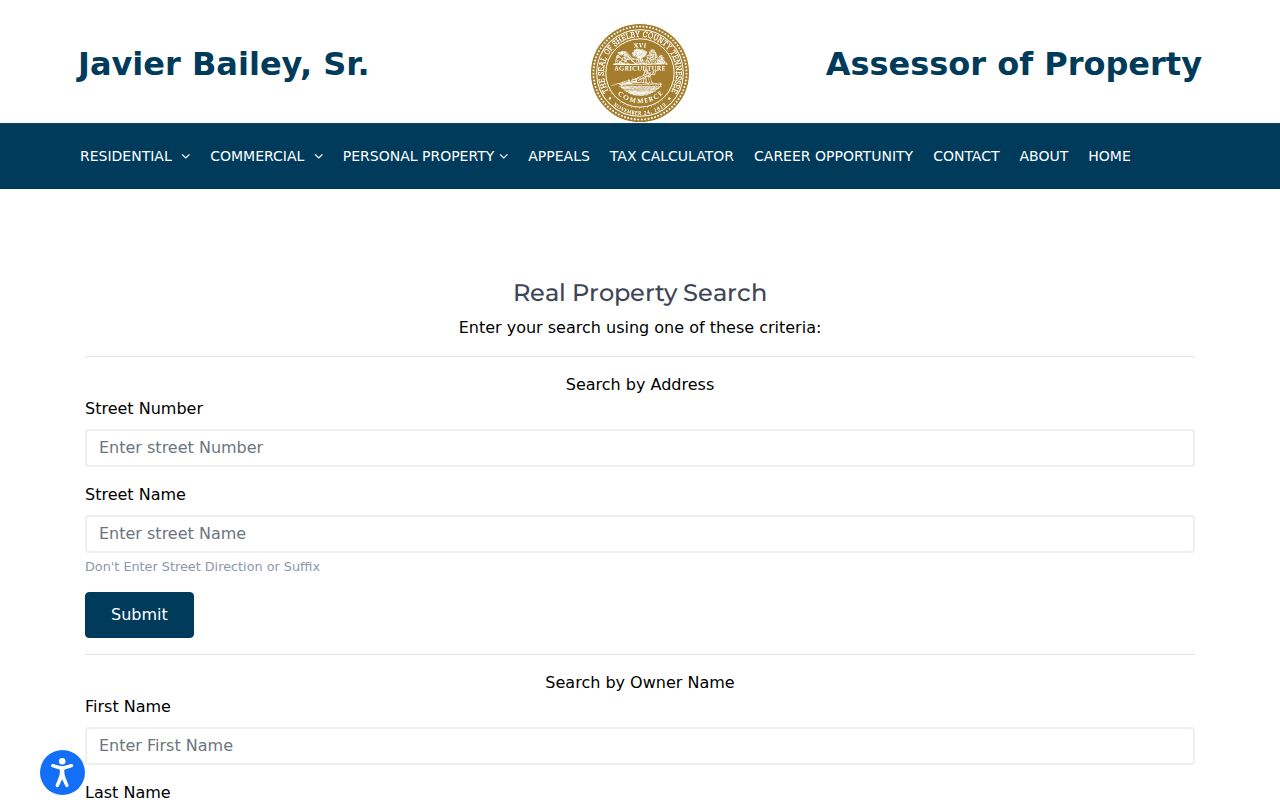
The result of this step is not a list of former occupants. It is a stable parcel handoff for checking the Register, ReGIS, plats, and address-based city records.
- Situs address
- The physical property-location address used for the parcel.
- Parcel ID
- The official identifier that connects an assessor, map, tax, or recorded-property record.
- Legal description
- The lot, block, subdivision, tract, or other recorded description used to identify real property more reliably than a changing street label.
Trace Previous Residents Through Shelby Deeds
The recorded chain is an ownership path, not a complete residency list. Start with the current owner as grantee, the person or entity that received an instrument, then find the newest likely deed. The seller on that instrument is the grantor. Search that prior owner as a grantee to locate the earlier purchase, keeping the parcel and legal-description terms beside every name. A chain can move through an estate, trustee, business, or trust without the house itself changing hands in the way a surname search suggests.
- Get the current parcel ID, owner, subdivision, lot or block, and legal description from the assessor record.
- Use the Shelby Register property index to search the current owner as grantee and review the newest likely deed.
- Record the instrument type, recording date, number, book or page, grantor, grantee, and any prior-instrument reference.
- Search the seller as grantee, then repeat one conveyance at a time while carrying the same legal-description clues.
- When images or indexing end, ask the Register or Archives for the specific buyer, seller, date, and address or legal description.
A warranty deed, quitclaim deed, trustee’s deed, and mortgage should not be treated as the same event. A mortgage is financing evidence, not a conveyance. If the old deed has no modern address, compare its subdivision and lot with the ReGIS parcel polygon or a recorded plat before moving to a different name match.
The Shelby Register’s public search is the starting screen for the grantor, grantee, address, parcel or lot, and instrument routes used in this backward check.
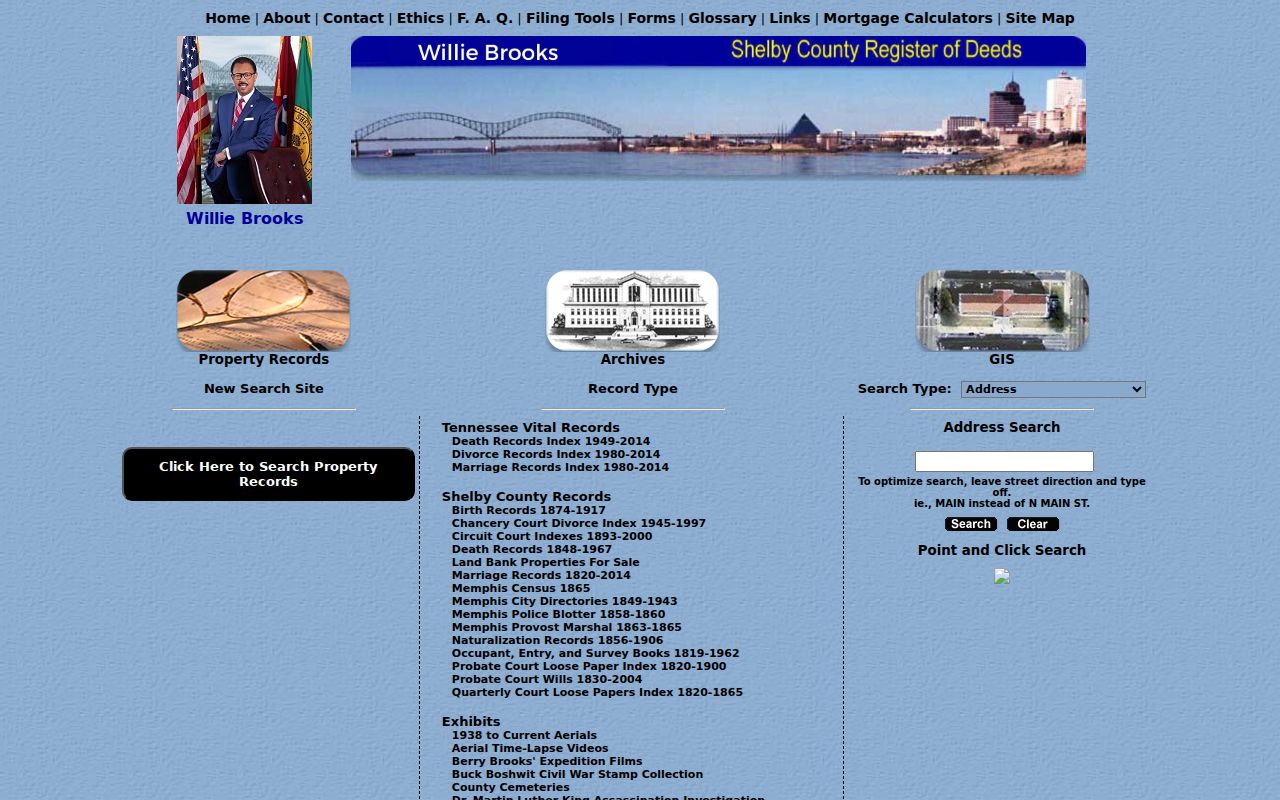
Record the returned instrument and the source location for its image or office copy, then verify that its legal description matches the same parcel before treating it as part of the chain.
- Grantor
- The person or entity conveying an interest in a recorded instrument.
- Grantee
- The person or entity receiving that recorded interest.
- Chain of title
- The sequence of recorded ownership transfers for a parcel, checked from one instrument to its prior link.
Germantown Previous Residents and Index Gaps
The Register’s public property search is current, but the research did not locate a single stated online start year for the modern index. The same archive identifies partial historic material, including occupant, entry, and survey books from 1819 through 1962. Treat the online and archive routes as overlapping layers, not as proof of one continuous digitized chain. Ask the Register to confirm the handoff for the parcel and date you need.
Older research can also use the archive’s listed marriage records, probate material, and regional directory volumes. A missing web result may mean an image-only series, an unindexed book, an archive copy, or a record kept by another office. The Register’s FAQ says mail requests need enough information for staff retrieval. Its published office-copy price is $0.50 per page, while plats are $1.50 per page.
Insider tip. Give the Register the buyer or seller, approximate date, and address or legal description when requesting an older deed copy by mail.
Note: Confirm the exact index coverage with the Register instead of assigning an unsupported online cutoff year.
Pair Past Residents With Directories and Census
Deeds identify recorded parties, yet former occupants may be found more clearly in a directory or census schedule. The Register archive lists Memphis City Directories from 1849 to 1943, but a given volume must be checked for Germantown coverage. The Germantown Regional History and Genealogy Center has more than 440 rolls of microfilm, historical maps, local files, and newspaper abstractions. Use these as household layers beside the parcel trail, not as substitutes for a deed.
A federal census is a household count on its schedule date. A city directory or telephone volume is a printed snapshot. Build a dated sequence by matching each discovered directory year with the nearest released census, then check an obituary, cemetery reference, or probate record when a person disappears from the address. The historical shelf and its limits are covered in the Germantown city directory collections.
- Save the historic address and printed name from the directory page.
- Check nearby directory years for a move, initials, or changed household notation.
- Compare the closest released census for household and relationship context.
- Use a parcel, deed, or plat to reconcile an old street form with the current address.
- Use obituary, cemetery, or probate material as an endpoint clue, not as automatic proof of residence.
Note: Germantown directory and census evidence can support a household history, but neither replaces a recorded title search.
Date Germantown Previous Residents With Maps
A house-history question can often be narrowed without asserting who occupied a property. GRHGC holds historic-home vertical files, maps, photographs, clippings, oral histories, and non-circulating books. The city engineering route covers demolition, grading, foundation, right-of-way, pool, and related project records, while the zoning and property-letter request can seek site-specific permits, plans, conditions, and open violations. The research did not locate a promised historical public permit index, so request a specific address or project rather than a person report.
The Library of Congress has a digitized Memphis and Shelby County Sanborn volume dated 1907 to November 1950 with 117 sheets. It can provide building-footprint context where a sheet covers the relevant place, but Germantown coverage was not verified. A plat, permit, first directory appearance, newspaper notice, and later deed are independent clues. No single one establishes that a specific person lived at the address.
Germantown Previous Residents Under Old Names
Historical place labels are a real search problem. Germantown began as Pea Ridge in 1833, became Germantown in 1836, and temporarily used Neshoba during World War I. Charter and annexation references from 1903, 1921, March 8, 1955, and later ordinances mean that a tract can have a different city relationship at different dates. Search the old place names, then use the legal description and plat to establish whether the record concerns the same physical property.
The city’s postwar growth also matters. Development shifted from a rural and rail-centered place toward subdivisions, schools, churches, and commercial corridors. A Memphis or Shelby County entry may be the correct regional lead for an earlier era, even when the modern parcel now carries a Germantown address.
Note: Search Pea Ridge and Neshoba alongside Germantown when an older record cannot be found under the modern name.
Germantown Previous Residents Research Limits
Address records require restraint. An owner’s tax mailing line is not proof of current or former occupancy. Renters, household members, mail recipients, utility customers, delivery information, and motor-vehicle addresses are not reliable public address lists. Tennessee Safe at Home can provide a substitute address for qualifying participants, although it does not replace an address in property-tax or recorded-real-property documents. Keep source labels and dates with every address rather than joining unrelated entries into a claim about a living person.
Use past-resident research for family history, estate questions, historic-property context, or personal curiosity. Stop at the source’s stated date and purpose. A specific request to the city or county custodian is better than trying to infer a protected or private address from disconnected records.
Lawful use. Germantown previous-resident research is for personal, historical, and family purposes. Do not use records to stalk, harass, threaten, or track anyone.